
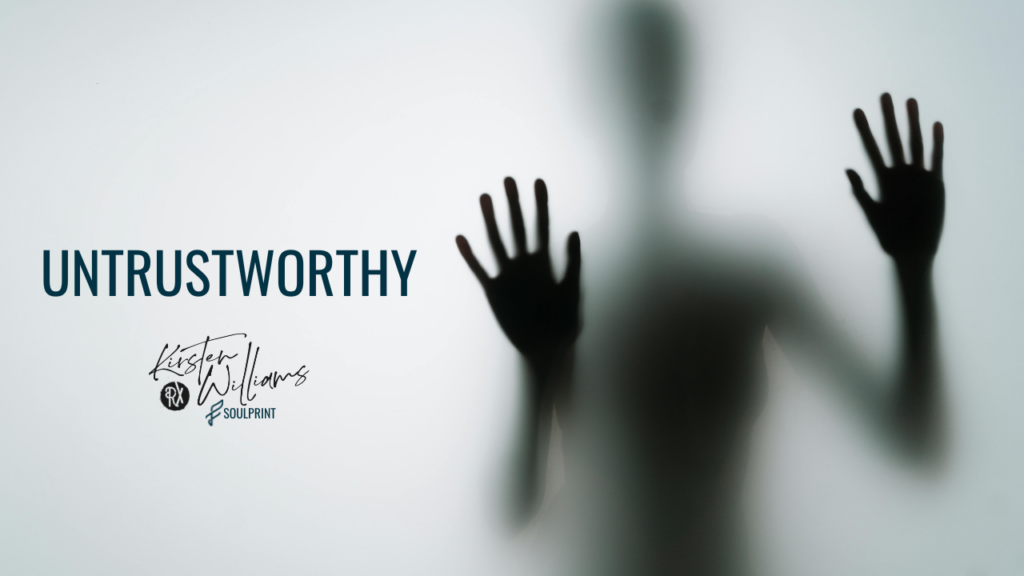
It’s a word that lingers when it’s spoken, it’s heavy, vague, and oddly impersonal. Recently, it was used about me. At first I reacted, disappointment flooded my heart. Then I felt hurt… knowing who said it and who repeated it to others. But as I settled into thinking more deeply about it, I felt compelled to pause, not to defend myself, but to understand what was being named.
So I looked closer.
Untrustworthy is defined as dishonest. Immoral. Lacking accuracy. Unreliable.
Admittedly my thoughts spiralled down the rabbit hole for a while… Am I that person? After a good… long… hard… look at myself, the things I’ve done, the positions I’ve held and more I landed at ground zero… none of those definitions accurately reflect the way I’ve lived my life… EVER!
I’ve always been the responsible one, the person who takes things too seriously at times, the person who lives with a strong moral compass, the person who values honesty over self-preservation and the person who keeps the facts the facts. If anything, I’ll often sabotage myself in order to do the right thing so I don’t let people down.
And that realisation didn’t spark anger, it brought clarity.
When someone questions your trustworthiness (particularly those you’ve been close with), especially when you know you are acting in alignment, the ache runs deeper than reputation. It reaches deep into your identity. Not because the accusation is true, but because integrity lives close to your core. When it’s challenged, the nervous system feels it before the mind can organise words (that explains the rabbit hole spiral).
One thing I’ve realised to do is not respond or react, but regulate myself when you hear something that’s not true about yourself. And regulation is difficult at times when your body/nervous system throws continual spanners into your day, but I’m getting better at it… We like to react, we like to be angry, offended, or even revengeful in moments when our character is being questioned.
I’m learning now to breathe into the moment, even more.
Pause long enough to stay inside myself. Give it space to land accurately within me.
Check my spirit and intention and adjust accordingly.
Reactivity rarely restores trust. It often fractures it further.
In Soulprint terms, this is the moment to return to centre, to remember that trust is not proven through defence, but through coherence over time.
You can clarify intention, but you cannot manage perception.
Alignment asks you to release that illusion.
Trust is not declared.
It is experienced.
A few truths hold here:
- Trust is a long game, built quietly and tested publicly.
- Integrity reveals itself most clearly when misunderstanding enters the room
- Defensiveness protects the ego; grounded honesty protects the relationship.
- Trust, I’ve learned, doesn’t announce itself.
It doesn’t campaign.
It doesn’t explain. - Trust moves quietly beneath the surface of our lives.
- It’s felt before it’s named.
- When trust is present, something subtle shifts; people soften, conversations deepen, resistance eases. There’s less need for performance because something stable is already holding the space.
- And when trust is absent, the body knows it instantly.
- Tension creeps in. Words are weighed. Safety contracts.
When accusation is present, especially a misplaced one, the work is to anchor the conversation in what is yours to hold: intention, pattern, and presence. Not persuasion. Not self-abandonment.
You might name that alignment gently, without asking to be believed:
I can’t control how my actions land. What I can stand by is the consistency of how I choose, show up, and return to alignment. If there’s a gap between expectation and experience, I’m willing to explore it.
This is Soulprint leadership.
Not loud.
Not fragile.
Not grasping.
Trust is repaired in presence, not argument.
In steadiness, not strategy.
In humility that doesn’t collapse and confidence that doesn’t harden.
At the core of trust lives integrity, not as a concept, but as alignment.
Integrity is when who you are, what you say, and how you act move in the same direction.
It’s not polished. It’s not strategic.
It’s practiced.
Integrity is lived in ordinary moments. In choices no one applauds. In decisions that cost something. In the quiet refusal to fracture yourself for approval. Over time, this coherence becomes unmistakable. People feel it. And eventually, they rely on it.
This is how trust becomes legacy.
Integrity is sometimes mistaken for predictability. But what it actually offers is safety. The kind that says, You can count on me, not because I’m easy, but because I’m anchored.
- I see this in leaders who stay present when discomfort rises instead of disappearing.
- In practitioners who hold empathy without abandoning boundaries.
- In relationships where listening matters more than being right.
These moments rarely look impressive. But they ripple far beyond themselves.
Trust is not about charisma. It’s about consistency.
Not about control, but coherence.
Every aligned decision becomes a point of orientation for others. Not a command, an invitation. A quiet reminder that leadership doesn’t require dominance, only integrity. That alignment can be chosen, again and again, even when the ground feels uncertain.
Trust is etched in these rhythms. Not loudly. But permanently.
So let trust be the melody we return to – not in words, but in motion. Let our lives carry a steadiness others can feel long after we’ve left the room. And perhaps the truest measure of legacy is not the stories told about us, but the safety others discover in themselves because we chose to live aligned.
Over time, those who need to lean on your integrity will recognise it, not because you convinced them, but because the way you live your life in alignment makes itself undeniable.
And what doesn’t settle… was never yours to carry.
Trust is not about charisma. It’s about consistency.
Not about control, but coherence.
Every aligned decision becomes a point of orientation for others. Not a command, an invitation. A quiet reminder that leadership doesn’t require dominance, only integrity. That alignment can be chosen, again and again, even when the ground feels uncertain.
Trust is etched in these rhythms. Not loudly. But permanently.
So let trust be the melody we return to – not in words, but in motion. Let our lives carry a steadiness others can feel long after we’ve left the room. And perhaps the truest measure of legacy is not the stories told about us, but the safety others discover in themselves because we chose to live aligned.